
Gold turned up this past week as US Treasury Secretary, Scott Bessant, sought to rein in the rising yields of 30 and 10-year US Treasuries. His efforts to buy longer-dated debt and fund it with shorter term treasuries was not entirely successful. Bessant’s actions and their apparent impotence remind markets of certain uncomfortable truths that investors should not forget. Just this past week, US debt surpassed $40 trillion and the US debt to GDP ratio is 122.6%. Interest expense on the 2026 budget is approximately $1-1.21 trillion and now is larger than national defense. Social Security will be unable to meet all its commitments by 2032 and pay out only 78% of total scheduled benefits. The massive Artificial Intelligence CapEx boom, that is increasingly being financed by US tech giants, will raise interest rates and increase interest rates on US national debt. Since 2011, the three primary credit rating agencies have downgraded US Treasuries commencing on August 5, 2011, with Standard and Poor’s. The storm clouds are clearly growing.
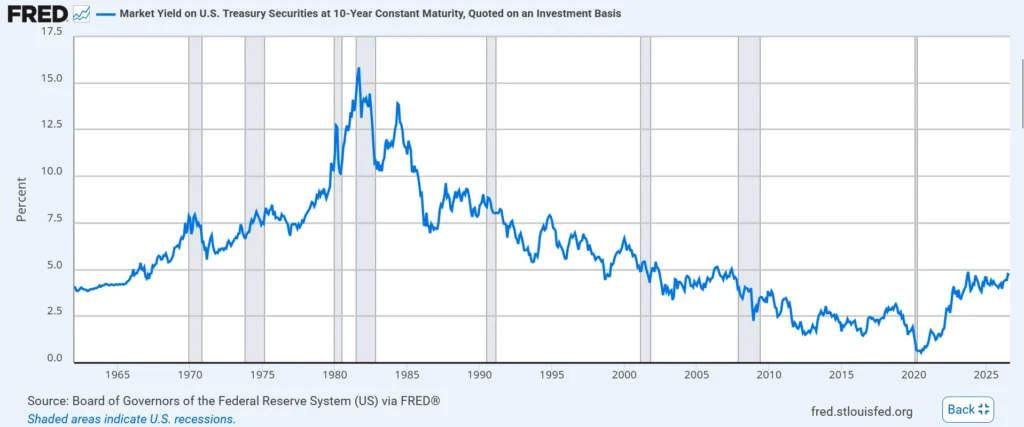
Renowned investor, Ray Dalio wrote this week that investors should sell some bonds and put 10 -15% of their assets in gold. Dalio’s call may be the most important bond call since renowned economist Henry Kaufman famously called the peak in interest rates on August 17, 1982. 10-year US Treasury rates actually peaked at 15.82% in August 1981, as shown below, but Kaufman’s call confirmed a secular change in rates which persisted until July 2020, when 10-year Treasury yields bottomed at 0.55%. Dalio’s call may not only reflect a secular shift to higher rates but a secular shift in the logic of owning gold in investors’ portfolios.
Ray Dalio is one of the great investment managers today. He notes in his recently released book, How Countries Go Broke, that nearly 80 percent of currencies, since the 1700s have become worthless, which is why Dalio’s recommendation this past week that investors put 15% of their investments into gold is important. Gold is the historic hard monetary asset which is in limited supply and cannot be printed. If, as we have argued, we are now in a period of global currency debasement, gold should be an excellent hedge against potential financial crises that increasingly appear to be rising globally.
We have noted in the last year that a series of leading investment experts have been calling for gold price targets that not long ago were considered laughable. Pierre Lassonde, the billionaire founder of Franco Nevada and inventor of the Lassonde curve, forecast that gold could reach $17,250/ ounce in 2032. Crescat Capital recently wrote that gold could reach $20,000/ounce in the next four years based on monetary expansion and relative asset values. Crescat Capital is a gold mining specialist firm with $500 million in gold mining assets. Jim Rickards who predicted $10,000/ounce of gold in 2016, when he wrote The New Case for Gold and gold’s price was $1200/ounce, is finding new respect and forecasting a AI Bubble as well. Stanley Druckenmiller posted a very timely YouTube presentations on why this year’s pullback in gold is a typical global shock correction, where these pullbacks typically form a low which precedes a major sustained upward move in gold. DoubleLine CEO Jeffrey Gundlach said last October that a 25% gold allocation was not excessive. And, last September, Morgan Stanley’s Chief Investment officer, Mike Wilson, recommended switching from a 60/40 stock – bond allocation to a 60/20/20 stock – bond – gold allocation with bonds being sold and gold being purchased with those proceeds.
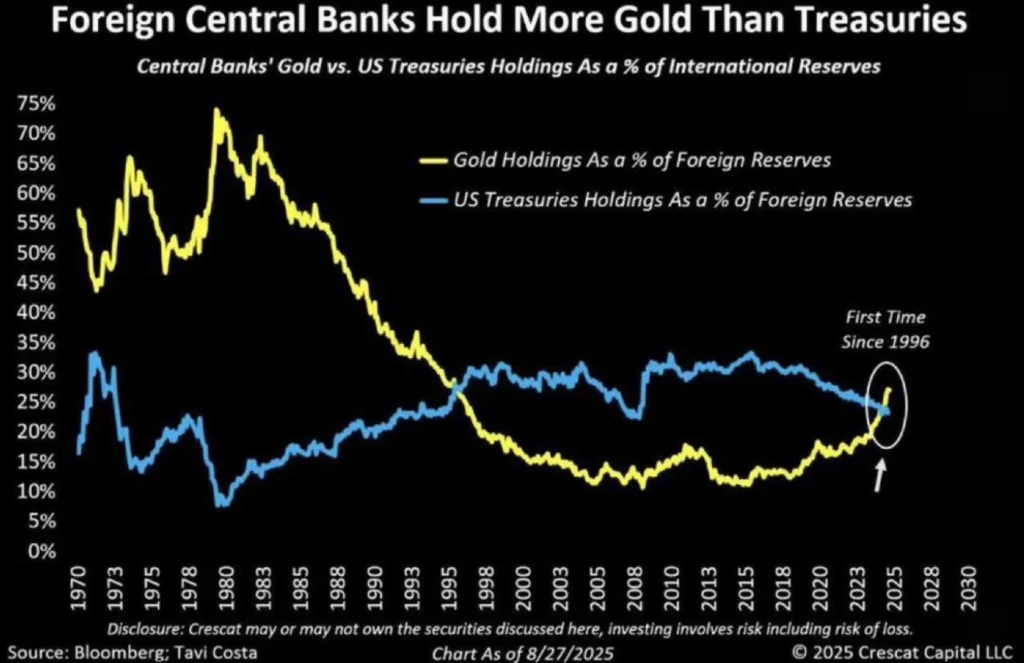
Ten to 15 years ago investment legends Warren Buffett and John Bogle argued that gold was simply a speculation with no intrinsic value, cash flow or dividend. Today, we see tangible value and demand for gold and gold miners. Most importantly, gold is being bought by foreign central banks to facilitate international trade and, as of this year foreign central banks own more gold than US Treasuries. The chart below by Tavi Costa of Crescat Capital showed this new trend last August 27th.
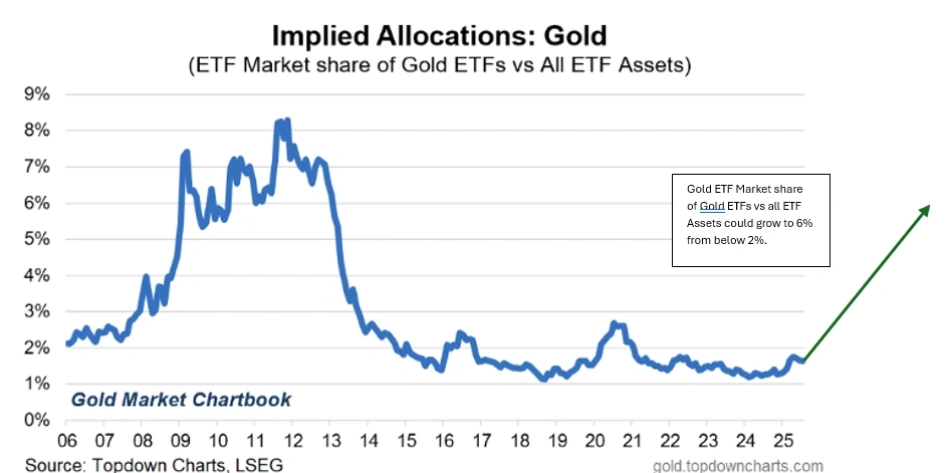
The second driver for gold demand is related to a shift in traditional asset allocation models due to changing fundamental factors like inflation, dollar weakness, and interest rate expectations. Today, we see demand for gold as asset allocation models shift from the 60/40 stock-bond allocation and begin allocating up to 25% into gold miners and gold. In aggregate, we could see, based on the chart below, that aggregate gold allocations could quadruple over the next 4-5 years.
Market cycles based on inflationary and deflationary cycles argue that we are in an inflationary cycle and cyclical stocks like minerals and miners and commodities are entering a boom similar to the 1970s and the 1999-2011 cycle.
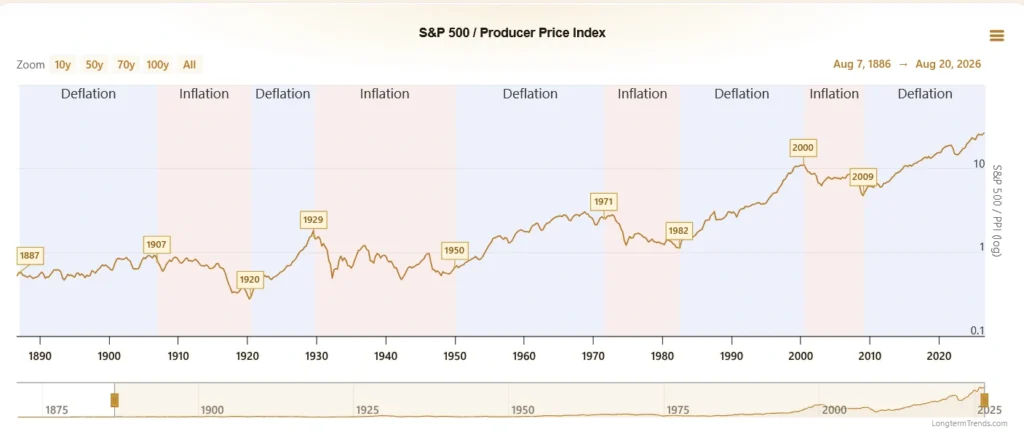
We believe that the commodity supercycle is being driven in part by the need for commodities to build the AI and US manufacturing boom in the US. This has been brilliantly highlighted by Dan Dreyfus of Bornite Capital who argues that we will see a resurgence in mining company as the US has grossly under invested in infrastructure over the last few decades. Mining companies and gold mining companies based on the implied cycle examples above, should enjoy about 10 years of cyclical upside.
To get exposure to this sector there are many ways to invest. The most conservative way to invest is with a dollar cost averaging methodology into gold mining indices like the VanEck Gold Mining ETF (GDX) and the VanEck Junior Gold Mining ETF (GDXJ).
The most aggressive and speculative way to invest is through individual junior gold miners and the name we favor for that is Blue Lagoon Resources, Inc. (BLAGF) which is now producing nearly 150 tons of ore a day, generated over $10 million in revenues, and due to report their fiscal second quarter in the coming days and weeks. And that quarter should be very profitable and generate about $3.5 million in cash flow. With drilling to commence this September, Blue Lagoon will begin exploration and will then begin to report increases in their 43-101 qualifying resources. Presently, the company has 225,000 ounces of measured gold, but that number should grow to one million ounces in the next year via infill drilling; however, if their exploration drilling program starts producing new gold, the market cap of Blue Lagoon could begin to rise dramatically. The Lassonde curve shows that in the life cycle of a gold miner, when the company enters into the exploration phase, a resource company will see its most rapid stock price appreciation.
K92 Mining Inc. is a $5.39 billion market capitalization high growth gold miner in Kuala Lampur. Quinton Hennigh, PhD., the geologist who led Crescat Capital to fund Blue Lagoon’s resource development, believes K92 Mining Inc. is the best example of Blue Lagoon’s potential growth in the future. KNTNF has a massive carbonite type gold deposit which is associated with some of the largest resources in the world. KNTNF resides in Papua New Guinea near Australia and close to Porgera Gold Mine a top 10 producing gold mine with approximately 32 million ounces of gold. The diagrams below from its investor packet reflect its high growth track record.
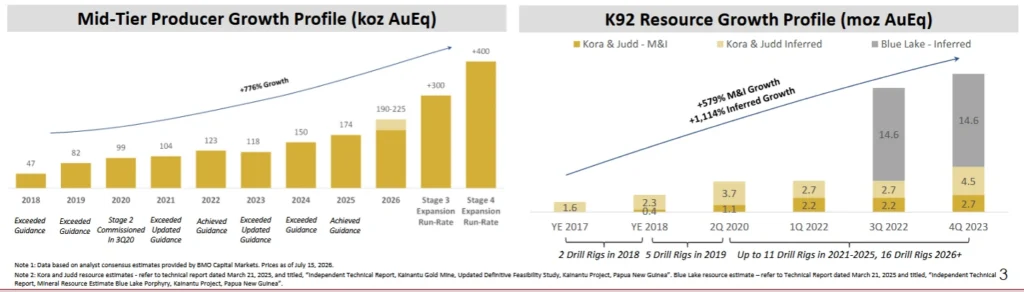
Its recent earnings report reflects its impressive growth profile.
Lastly, we like GAMCO Global Gold & Natural Resource and Income Trust (GGN). GGN is an excellent closed end fund which provides high income generated from covered call option writing and yields 7.39%. Since gold does not offer a yield, this fund offers both a high correlation to the price of gold and an attractive yield which is especially enticing to an investor is selling bonds and allocating to gold.
Conclusion:
The case for a rebound in gold and resumption of a secular move higher in gold and, by extension, gold miners suggests that we are likely spot on in being bullish on gold today. Furthermore, if you are not long gold and heavy in bonds, investors would be wise to reduce their bond holdings in a portfolio especially if those bond holdings are 40% of one’s portfolio and or have meaningful interest rate or credit risk.
We sense that this pullback marks a mid-cycle pullback such as was experienced in 2009 during the 2002 to 2011 gold rally.
Gold miners are fundamentally cheap and can generate substantial income and cash flow. With our belief that this could indeed be the beginning of a meaningful move higher in the price of gold, the upside for gold mining stocks should be much higher than gold, which could be extraordinary if Pierre Lassonde or Crescat Capital’s price targets are correct. In fact, we believe gold mining stock investors could be positioned for one of the strongest bull markets investors may experience during their lifetime; however, gold is a commodity and volatility can be high, so protecting those gains is critical. Our risk management caution stands in stark contrast to a buy and hold position one my apply to a great growth stock like Amazon.com Inc. (AMZN), Apple Inc. (AAPL) or Walmart Inc. (WMT) – so called “one-decision” stocks.
Gold and gold mining stocks will be volatile, but their potential upside today appears to be rare, and one should seriously consider employing a reduction in bonds and purchase gold and gold mining stocks. This call, we believe, is a particularly timely investment call. Several investment greats appear to agree, but there is no market consensus, yet a compelling value case can be made for owning gold and gold ming stocks.